NBC's chief medical editor, Dr. Nancy Snyderman, shares important facts about the most serious form of skin cancer, melanoma
0 comments Posted by Sun Safety Alliance at 2:12 AMVisit msnbc.com for Breaking News, World News, and News about the Economy
This is a study by the National Institutes of Health and AVAX Technologies to determine whether M-Vax is effective in shrinking melanomas that have spread (stage IV). To increase it effectiveness, the M-Vax dosing will be followed by administration of low doses of interleukin-2 (IL2), a marketed drug that is known to stimulate immunity and cause some shrinkage of melanomas. This national study is currently recruiting patients who have Stage IV melanoma and who meet the study's other criteria.
M-Vax + Low Dose Interleukin-2 Versus Placebo Vaccine in Metastatic Melanoma in Patients With Stage IV Melanoma
Purpose
Previous studies suggests that M-Vax, a melanoma vaccine prepared from patients own cancer cells, can stimulated patients' immune system to react against their cancer. AVAX has identified a dose and schedule of administration of M-Vax that work optimally. In this study, AVAX will determine whether M-Vax is effective in shrinkage of melanomas that have spread (stage IV). To increase it effectiveness, M-Vax administration will be followed by administration of low doses of interleukin-2 (IL2), a marketed drug that is known to stimulate immunity and cause some shrinkage of melanomas.
Two-thirds of patients will receive M-Vax + IL2, and one-third will receive a placebo vaccine + IL2. The study is blinded so that neither the patients nor their physicians know which material they are receiving.
To be eligible for this study, patients must have at least one melanoma tumor that can be surgically removed and made into a vaccine. In addition, they must have melanoma that has spread to to the lungs or to soft tissue sites (under the skin, on the surface of the skin, lymph nodes). Eligible patients may have previously received one treatment (for example, chemotherapy) for their melanoma.
Side effects of M-Vax are expected to be mild; the most common is the development of sore pimples at the site of vaccine injections. The low dose IL2 may cause some fatigue and other mild symptoms.
It is expected that 387 patients will be treated in this study.
Eligibility
| Genders Eligible for Study: | Both |
| Accepts Healthy Volunteers: | No |
Inclusion Criteria:
Stage IV metastatic melanoma of cutaneous or mucosal origin or without known primary site
- At least one metastatic mass that is surgically resectable, excluding metastases in brain, bowel, or bone
- Successful preparation of a vaccine that meets quality control release criteria
- Following surgery for vaccine preparation, subjects must have at least one measurable metastasis defined by modified RECIST criteria. Non-measurable metastases may also be present. Residual metastases (measurable or non-measurable) must be limited to skin (dermal or subcutaneous), lymph node, or lung, or a combination of these.
- No prior systemic treatment or one prior systemic treatment for metastatic melanoma, not counting post-surgical adjuvant treatment with alpha interferon
- Minimum of one month and maximum of 4 months since the surgery
- Expected survival of at least 6 months
- Karnofsky performance status at least 80
- Signed informed consent
Exclusion Criteria:
Failure to prepare a vaccine that meets all quality control release criteria
- Uveal melanoma
- Post-surgical residual metastases in sites other than specified in 6.1
- Brain metastases, current or past (unless successfully treated at least one year prior to enrollment)
- Hepatic transaminase > 2.5 x ULN
- Total bilirubin > 2.0 mg/Dl
- Creatinine > 2.0 mg/Dl
- Hemoglobin <>
- WBC <>
- Platelet count <>
- Limited field radiotherapy, i.e., limited to recent surgical site, less than 4 weeks prior to first dose of vaccine
- Major field radiotherapy less than 6 months prior to first dose of vaccine
- Any systemic treatment for metastatic melanoma, including chemotherapy, cytokines, or investigational drugs less than 2 months prior to first dose of vaccine
- Previous administration of M-Vax
- Prior splenectomy
- Administration of systemic steroids less than 4 weeks prior to first dose of vaccine. Topical steroids are allowed during the study, provided these are not applied to vaccine injection sites. Inhaled aerosol steroids also are allowed during the study.
- Administration of immunosuppressive drugs less than 4 weeks prior to first dose of vaccine
- Administration of antitubercular drugs (e.g., isoniazid, rifampin, streptomycin) less than 4 weeks prior to first dose of vaccine
- HIV 1/2 positive by ELISA, confirmed by Western blot
- Hepatitis B surface antigen or hepatitis C antibody positive
- Other malignancy within 5 years except: curatively treated non-invasive melanoma, non-melanomatous skin cancer, carcinoma in situ of the uterine cervix, or early stage (stage A or B1) prostate cancer
- Autoimmune diseases that would interfere with an immunologic response (e.g., systemic lupus erythematosus, multiple sclerosis or ankylosing spondylitis)
- Concurrent medical condition that would preclude compliance or immunologic response to study treatment
- Concurrent serious infection, including active tuberculosis, or other serious medical condition
- Pregnancy or lactation (serum human chorionic gonadotropin [HCG] test must be negative in fertile women at screening visit)
- Known gentamicin allergy
- Anergic, defined by the inability to make a DTH to at least one of the following: candida, mumps, tetanus or trichophyton (based upon availability)
| Contact: Francois Martelet, MD | 215-241-9760 | fmartelet@avax-tech.com |
| United States, Florida | |
| Baptist Cancer Institute | Not yet recruiting |
| Jacksonville, Florida, United States, 32207 | |
| Contact: Troy Guthrie, MD 904-202-7998 Troy.Guthrie@BMCJAX.com | |
| Principal Investigator: Troy Guthrie, MD | |
| United States, Illinois | |
| University of Illinois at Chicago Cancer Center | Recruiting |
| Chicago, Illinois, United States, 60612 | |
| Contact: Cathleen Schaffer, RN 312-413-3863 CSchaffe@uic.edu | |
| Contact: Michael Warso, MD warso@uic.edu | |
| Principal Investigator: Michael A. Warso, MD | |
| Cancer Treatment Centers of American - Midwestern | Recruiting |
| Zion, Illinois, United States, 60099 | |
| Contact: Joy Jardinico, RN 847-731-4143 joy-jardinico@ctca-hope.com | |
| Contact: Stephen Ray, MD stephen.ray@ctca-hope.com | |
| Principal Investigator: Stephen Ray, MD | |
| United States, Kentucky | |
| University of Louisville School of Medicine | Not yet recruiting |
| Louisville, Kentucky, United States, 40202 | |
| Contact: Deborah Hulsewede, CCRC, CCRP 502-629-3308 deborah.hulsewede@nortonhealthcare.org | |
| Principal Investigator: Kelly McMasters, MD | |
| University of Kentucky - Markey Cancer Center | Recruiting |
| Lexington, Kentucky, United States, 40536 | |
| Contact: Heather Dunn 859-257-4464 hldunn2@email.uky.edu | |
| Principal Investigator: John J Rinehart, MD | |
| United States, New Hampshire | |
| Dartmouth-Hitchcock Cancer Center | Recruiting |
| Lebanon, New Hampshire, United States, 03756 | |
| Contact: Dorie Belloni 603-653-3567 Dorothy.R.Belloni@Dartmouth.EDU | |
| Principal Investigator: Marc Ernstoff, MD | |
| United States, Oklahoma | |
| Cancer Treatment Centers of America - SouthWestern | Not yet recruiting |
| Tulsa, Oklahoma, United States, 74133 | |
| Contact: Michele M Sumner, BS 918-286-5450 Michele.Sumner@ctca-hope.com | |
| Contact: Pierre J Greef, MD 918-286-5450 | |
| Principal Investigator: Pierre J. Greef, MD | |
| United States, Pennsylvania | |
| Thomas Jefferson University | Not yet recruiting |
| Philadelphia, Pennsylvania, United States, 19107 | |
| Contact: Takami Sato, MD 215-955-1752 t_sato@mail.jci.tju.edu | |
| Principal Investigator: Takami Sato, MD | |
| St. Lukes Cancer Center | Recruiting |
| Bethlehem, Pennsylvania, United States, 18015 | |
| Contact: Kelly Filchner, MSN 610-954-3582 FilchnK@slhn.org | |
| Principal Investigator: Sanjiv Agarwala, MD | |
| University of Pennsylvania Cancer Center | Recruiting |
| Philadelphia, Pennsylvania, United States, 19104 | |
| Contact: Mary Carberry 215-614-1813 mary.carberryi@uphs.upenn.edu | |
| Principal Investigator: Lynn M Schuchter, MD | |
| United States, Texas | |
| MD Anderson Cancer Center | Recruiting |
| Houston, Texas, United States, 77030 | |
| Contact: Peggy Tong, RN 713-745-5030 PLTong@MDAnderson.org | |
| Principal Investigator: Jeffrey Lee, MD | |
| Belgium | |
| Universite Catholique de Louvain (UCL) | Recruiting |
| Brussels, Belgium, 1200 | |
| Contact: Aline Duquenne 32 2 764 5427 Aline.Duquenne@uclouvain.be | |
| Principal Investigator: Jean-Francois Baurain, MD | |
| Centre Hospitalier Regional de Namur | Recruiting |
| Namur, Belgium, 5000 | |
| Contact: Jean-Phillippe Hermanne, MD 32 81 72 60 30 Hermanne@ideone.BE | |
| Principal Investigator: Jean-Phillippe Hermanne, MD | |
| Study Director: | Francois Martelet, MD | AVAX Technologies |
Teen Vogue June/July sends teens mixed messages about sun safety
1 comments Posted by Sun Safety Alliance at 9:20 AM |
| From Sun Safety Alliance Photos |
In an attempt to join the "sun safety" advocacy bandwagon, Teen Vogue published a compelling story which they called: "Cruel Summer, Dying for a Tan". The article is very intelligently written by Beth James. She interviews Kaity Dorsett and Alexa Salvatore, among other teens that have been diagnosed with malignant melanoma. The article points out the terrifying facts that, yes!!! Teens can develop cancer and the article quotes the American Cancer Society in stating that one person dies every hour from skin cancer. Ms. James does a great job informing young adults about the dangers of tanning and the realities behind ultraviolet rays. She stresses the importance of sunscreen and reapplying and using the correct amount of sunscreen as well.
Excellent work Ms. Beth James.
Unfortunately in the same exact issue of Teen Vogue that worked to educate young women about the dangers of skin cancer, Editor in Chief Amy Astley allowed the following image for the spread titled "Summerland":
 |
| From Sun Safety Alliance Photos |
The accompanying text reads:
"Show off a sun-kissed glow in a chic white bikini."
On June 30th, Rachel Saslow of the Washington Post points out that "A caption mentions that the readers should get that glow with L'Oreal self tanning lotion, but that tiny-type disclaimer does little to offset the hypocrisy".
And Rachel is right. How dare Teen Vogue confuse young girls about sun safety. On one page the magazine educates girls about the terrifying realities of skin cancer and the harshness of the sun. On the next page the magazine is taunting the girls with sexy pictures of sun kissed models in skimpy bathing suits under the hot sun; clearly not showing any signs of practicicng Sun Safety whatsoever.
Amy Atsley, we ask you to please use your magazine as a tool to fight skin cancer. Do not send mixed messages to our children. We thouroughly enjoyed your article on melanoma and look forward to more truthful and educational write ups. These enrich the minds of our easily influenced young ones. Yet on the same note, please be careful of the images that you are selling to the same persuadable audience. Skin cancer is real, as your own article points out, and images such as these simply encourage girls to get out to the beaches and soak up some sun. They hinder the reality of skin cancer and give them the impression that, "That sort of thing can't happen to me".
When it can.
And it will.
Please protect yourselves today folks.
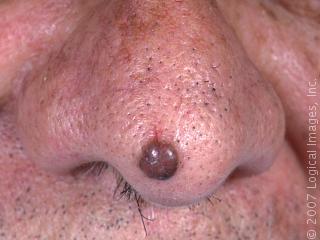
Basal Cell Carcinoma—
 |
| From Sun Safety Alliance Photos |
Basal cell cancer most often appears on sun-exposed areas such as the face, scalp, ears, chest, back, and legs. These tumors can have several different forms. The most common appearance of basal cell cancer is that of a small dome-shaped bump that has a pearly white color. Blood vessels may be seen on the surface. Basal cell cancer can also appear as a pimple-like growth that heals, only to come back again and again. A less common form called morpheaform, looks like a smooth white or yellowish waxy scar. A very common sign of basal cell cancer is a sore that bleeds, heals up, only to recur again.
Squamous cell carcinoma—
 |
| From Sun Safety Alliance Photos |
The second most common cancer of the skin. More than 250,000 new squamous cell carcinomas are diagnosed every year in the United States. Middle-aged and elderly people, especially those with fair complexions and frequent sun exposure, are most likely to be affected.
The cancer develops in the outer layer of the skin (the epithelium). Some squamous cell carcinomas arise from small sandpaper-like lesions called solar (sun) or actinic keratosis. It is possible for squamous cell carcinoma to spread to other areas of the body; therefore, early treatment is important.
Melanoma (cutaneous melanoma)—
 |
| From Sun Safety Alliance Photos |
Melanoma is a cancer of the pigment producing cells in the skin, known as melanocytes. Cancer is a condition in which one type of cell grows without limit in a disorganized fashion, disrupting and replacing normal tissues and their functions, much like weeds overgrowing a garden. Normal melanocytes reside in the outer layer of the skin and produce a brown pigment called melanin, which is responsible for skin color. Melanoma occurs when melanocytes become cancerous, grow, and invade other tissues.
Melanoma begins on the surface of the skin where it is easy to see and treat. If given time to grow, melanoma can grow down into the skin, ultimately reaching the blood and lymphatic vessels, and apread around the body (metastasize), causing life-threatening illness. It is curable when detected early, but can be fatal if allowed to progress and spread. The goal is to detect melanoma early when it is still on the surface of the skin.

Avoid skin cancer. Use sun screen and always reapply. Wear UV protected clothing. Keep a close eye on your skin throughout the year and check your moles for the ABCs of skin cancer detection!
SELF Magazine, MSNBC, and Dr. Elizabeth Tanzi work to educate the public about the severity of melanoma.
1 comments Posted by Sun Safety Alliance at 10:27 AMDr. Elizabeth Tanzi, (@SkinLaserMD), is an internationally-known author and lecturer on cosmetic dermatology and cutaneous laser surgery. She joined the Washington Institute of Dermatologic Laser Surgery in 2001 and currently serves as the Co-director of Laser Surgery. Dr. Tanzi also holds a position as clinical Instructor in the Department of Dermatology at Johns Hopkins Hospital Center. Dr. Tanzi pursued her medical education at the Upstate Medical Center in Syracuse, New York, where she graduated in the Alpha Omega Alpha. You can visit her website as well at skinlaser.com
Dr. Tanzi is also a skin cancer survivor.
She was recently featured in SELF magazine as well as on the Today show to educate audiences about the seriousness of skin cancer. During the interview, Dr. Tanzi draws attention to many excellent points, that we at the Sun Safety Alliance also hold strong to be advocates of.
"1 million new cases of skin cancer are diagnosed yearly". Skin cancer is on the rise, and people must become smarter while in the sun. "People need to hear about the number of increased cases of skin cancer". Especially melanoma. It is "the most preventable and curable form of cancer", but also the most deadly. The Skin Cancer Foundation has stated that “one person every hour dies from melanoma”.
"30 SPF and up will block 97% of the sun's rays". Fight melanoma by applying and applying and reapplying. When most apply sunscreen, they only apply bare minimum. It's greasy and sticks to every thing. Sand and sunscreen are among the most obnoxious combination. Yet did you know you are supposed to apply an ounce of sunscreen every time you apply and reapply? "Reapply an ounce! That is so much!"
To encourage readers to protect themselves from melanoma, SELF-magazine has offered, in accordance with a recent Harvard study, to send a text message reminder about reapplying sunscreen. If you text SELFSKIN to 467467, you will receive four weekly alerts reminding readers to reapply.
“The only safe tan is a fake tan”. Dr. Tanzi explains that tanning beds are the equivalent of smoking and should not be used. Many young people today are in denial that skin cancer is real and they subject themselves to skin cancer by roasting in tanning beds. They do not understand the severity, look through some of the quotes pulled from twitter:
@Farraaa: “tanning.. yay skin cancer”
@taylordawnn: “tanning again. Skin cnacer? Probably”
@adeledgirltellem“so one of my best friends has skin cancer & i promised i'd stop tanning & such. but i cant do it! sorry bbygrl- LAYING OUT @ the beach <3
Though it is frustrating that a twitter search on "skin cancer" brings up a number of people that are ignorant to the realities of the disease, there are a few that advocate sun safety and skin cancer awareness. Those of us that have the knowledge and the evidence that skin cancer is on the rise must continue to educate those around us. Because many are unaware the severity of skin cancer and it's our job to inform them.
 |
| From Sun Safety Alliance Photos |
Melanoma is the most serious type of skin cancer. It begins in skin cells called melanocytes.
Melanocytes are the cells that make melanin, which gives skin its color. Melanin also protects the deeper layers of the skin from the sun's harmful ultraviolet (UV) rays.
When people spend time in the sunlight, the melanocytes make more melanin and cause the skin to tan. This also happens when skin is exposed to other forms of ultraviolet light (such as in a tanning booth). If the skin receives too much ultraviolet light, the melanocytes may begin to grow abnormally and become cancerous. This condition is called melanoma.
How and where does melanoma appear?
The first sign of melanoma is often a change in the size, shape, or color of a mole. But melanoma can also appear on the body as a new mole.
- In men, melanoma most often shows up:
- On the upper body, between the shoulders and hips
- On the head and neck
- In women, melanoma often develops on the lower legs.
- In dark-skinned people, melanoma often appears:
- Under the fingernails or toenails
- On the palms of the hands
- On the soles of the feet
Although these are the most common places on the body for melanomas to appear, they can appear anywhere on the skin. That's why it is important to always examine your skin to check for new moles or changes in moles.
With early diagnosis and treatment, the chances of recovery are very good.
The chance of getting melanoma increases as you get older, but people of any age can get melanoma. In fact, melanoma is one of the most common cancers in young adults. Each year, more than 50,000 people in the U.S. learn that they have melanoma.
Melanoma is a serious and sometimes life-threatening cancer. If melanoma is found and treated in its early stages, the chances of recovery are very good. If it is not found early, melanoma can grow deeper into the skin and spread to other parts of the body. This spread is called metastasis.
Once melanoma has spread to other parts of the body beyond the skin, it is difficult to treat.


