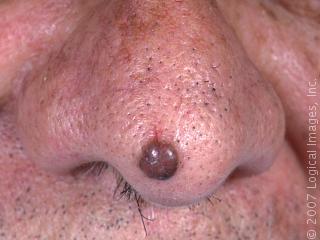
Basal Cell Carcinoma—
 |
| From Sun Safety Alliance Photos |
Basal cell cancer most often appears on sun-exposed areas such as the face, scalp, ears, chest, back, and legs. These tumors can have several different forms. The most common appearance of basal cell cancer is that of a small dome-shaped bump that has a pearly white color. Blood vessels may be seen on the surface. Basal cell cancer can also appear as a pimple-like growth that heals, only to come back again and again. A less common form called morpheaform, looks like a smooth white or yellowish waxy scar. A very common sign of basal cell cancer is a sore that bleeds, heals up, only to recur again.
Squamous cell carcinoma—
 |
| From Sun Safety Alliance Photos |
The second most common cancer of the skin. More than 250,000 new squamous cell carcinomas are diagnosed every year in the United States. Middle-aged and elderly people, especially those with fair complexions and frequent sun exposure, are most likely to be affected.
The cancer develops in the outer layer of the skin (the epithelium). Some squamous cell carcinomas arise from small sandpaper-like lesions called solar (sun) or actinic keratosis. It is possible for squamous cell carcinoma to spread to other areas of the body; therefore, early treatment is important.
Melanoma (cutaneous melanoma)—
 |
| From Sun Safety Alliance Photos |
Melanoma is a cancer of the pigment producing cells in the skin, known as melanocytes. Cancer is a condition in which one type of cell grows without limit in a disorganized fashion, disrupting and replacing normal tissues and their functions, much like weeds overgrowing a garden. Normal melanocytes reside in the outer layer of the skin and produce a brown pigment called melanin, which is responsible for skin color. Melanoma occurs when melanocytes become cancerous, grow, and invade other tissues.
Melanoma begins on the surface of the skin where it is easy to see and treat. If given time to grow, melanoma can grow down into the skin, ultimately reaching the blood and lymphatic vessels, and apread around the body (metastasize), causing life-threatening illness. It is curable when detected early, but can be fatal if allowed to progress and spread. The goal is to detect melanoma early when it is still on the surface of the skin.

Avoid skin cancer. Use sun screen and always reapply. Wear UV protected clothing. Keep a close eye on your skin throughout the year and check your moles for the ABCs of skin cancer detection!
Learn the A, B, C, D, E's of Skin Cancer Detection
5 comments Posted by Sun Safety Alliance at 1:20 AM |
| From Sun Safety Alliance Photos |
The ABCDE rule is a quick and helpful guide for detecting the usual signs of skin cancer. It is vital to monitor your skin and contact your doctor about any spots that match the following descriptions:
A- Asymmetry: Normal moles or freckles are completely symmetrical. If you were to draw a line through a normal spot, you would have two symmetrical halves. In cases of skin cancer, spots will not look the same on both sides.
B- Border: A mole or spot with blurry and/or jagged edges.
C- Color: A mole that is more than one hue is suspicious and needs to be evaluated by a doctor. Normal spots are usually one color. This can include lightening or darkening of the mole.
D- Diameter: If it is larger than a pencil eraser (about 1/4 inch or 6mm), it needs to be examined by a doctor. This is includes areas that do not have any other abnormalities (color, border, asymmetry).
E- Elevation: Elevation means the mole is raised above the surface and has an uneven surface.


