Basal Cell Carcinoma—
 |
| From Sun Safety Alliance Photos |
Basal cell cancer most often appears on sun-exposed areas such as the face, scalp, ears, chest, back, and legs. These tumors can have several different forms. The most common appearance of basal cell cancer is that of a small dome-shaped bump that has a pearly white color. Blood vessels may be seen on the surface. Basal cell cancer can also appear as a pimple-like growth that heals, only to come back again and again. A less common form called morpheaform, looks like a smooth white or yellowish waxy scar. A very common sign of basal cell cancer is a sore that bleeds, heals up, only to recur again.
Squamous cell carcinoma—
 |
| From Sun Safety Alliance Photos |
The second most common cancer of the skin. More than 250,000 new squamous cell carcinomas are diagnosed every year in the United States. Middle-aged and elderly people, especially those with fair complexions and frequent sun exposure, are most likely to be affected.
The cancer develops in the outer layer of the skin (the epithelium). Some squamous cell carcinomas arise from small sandpaper-like lesions called solar (sun) or actinic keratosis. It is possible for squamous cell carcinoma to spread to other areas of the body; therefore, early treatment is important.
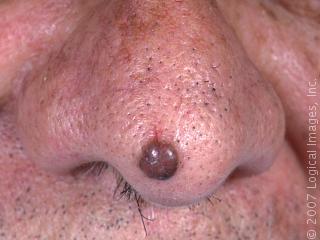
Melanoma (cutaneous melanoma)—
 |
| From Sun Safety Alliance Photos |
Melanoma is a cancer of the pigment producing cells in the skin, known as melanocytes. Cancer is a condition in which one type of cell grows without limit in a disorganized fashion, disrupting and replacing normal tissues and their functions, much like weeds overgrowing a garden. Normal melanocytes reside in the outer layer of the skin and produce a brown pigment called melanin, which is responsible for skin color. Melanoma occurs when melanocytes become cancerous, grow, and invade other tissues.
Melanoma begins on the surface of the skin where it is easy to see and treat. If given time to grow, melanoma can grow down into the skin, ultimately reaching the blood and lymphatic vessels, and apread around the body (metastasize), causing life-threatening illness. It is curable when detected early, but can be fatal if allowed to progress and spread. The goal is to detect melanoma early when it is still on the surface of the skin.

Avoid skin cancer. Use sun screen and always reapply. Wear UV protected clothing. Keep a close eye on your skin throughout the year and check your moles for the ABCs of skin cancer detection!


6 comments:
The consequences that cause the disease can lead to death, and so this disease is painful and people suffering from it suffers greatly by the constant pain caused by taking medications that are opioid narcotics such as Lortab ”http://www.findrxonline.com/buy-lortab-online.htm”
, Vicodin, hydrocodone, which are very effective in suppressing the pain that causes the disease, we hope that people care and know findrxonline adequately informed as well as notes on your site.
hi
hello in an exhibition of breastfeeding mastitis, I realized that the check with the doctor must be at least every 12 months and so rule out any disease.
nice
This curriculum gives you training in beauty, salon and parlor management. Become top beauty therapist. Thing of beauty is joy forever. Skin Institute
All thanks to Doctor James herbal mix medicine for using his herbal medicine to cure my MELANOMA DISEASE I suffered for years and it almost circulated all over my body and I seek for natural treatment. I found on the internet that Dr James uses his herbal medicine to cure many of people from the virus and I contacted him on his Email [drjamesherbalmix@gmail.com]. And he said he is going to help me ,after 2 days of reaching him.he prepared his herbal soap and medicine ans sent to me,and I used the medicine as he told me for 15 days,my skin cancer was cued and disappeared just as he told me it will after the use of his medicine which i never doubted him . At least his treatment cured me completely from melanoma disease. Hopefully it will be helpful for you as it happened with me. Dr. James herbal medicine is made of natural herbs, with no side effects, and easy to drink. I'm shearing my testimony to reach out to anyone suffering from this horrible skin virus should contact. or any type of human illness, including HIV / AIDS, herpes,cancer,Ovarian Cancer,Pancreatic cancers, bladder cancer,skin cancer, prostate cancer, Glaucoma., Cataracts,Macular degeneration,Cardiovascular disease,Autism,Lung disease. Enlarged prostate,Osteoporosis. Alzheimer's disease,psoriasis ,Tach Diseases,Lupus,
Dementia.kidney cancer, lung cancer, skin cancer, skin cancer and skin cancer.testicular Cancer, , LEUKEMIA, HEPATITIS, INFERTILITY WOMEN /.CONTACT EMAIL : drjamesherbalmix@gmail.com
Post a Comment